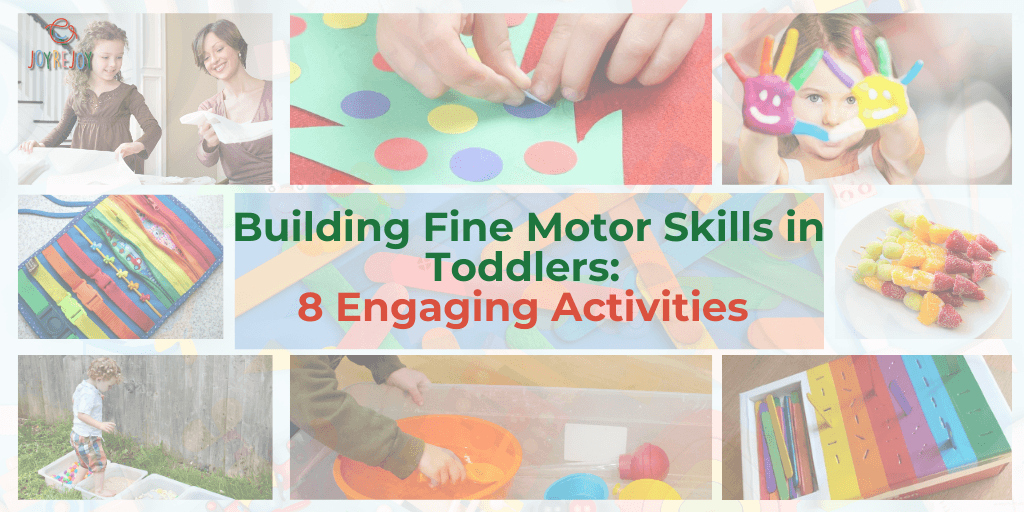
Fine motor skills help toddlers with tasks like eating, dressing, and writing. Activities like transferring water, folding napkins, and playing with stickers enhance hand-eye coordination, grip strength, and dexterity, boosting overall development.
What are Fine Motor Skills and why is it important?
Fine motor skills involve the coordination of small muscles, often requiring synchronization between the hands, fingers, and eyes. These abilities facilitate accurate and controlled movements necessary for activities such as picking up objects, using tools, fastening buttons on shirts, and writing.
Fine motor skills are crucial for various daily activities and are foundational for more complex tasks involving dexterity and coordination. These abilities commonly mature over time in children as they engage in practice and exploration during their early years.
Fine motor skills are essential for toddlers to complete everyday tasks like eating, dressing, writing, and using utensils. They also enable children to become more independent in self-care activities and future academic tasks.
Activities to Help Toddlers Develop Fine Motor Skills
1. Transferring water
- Material: One sponge, a dropper, one empty bowl, one bowl with water, and a cloth for wiping spills.
- How To Do It:
- Keep the bowl with water on the right and the empty bowl on the left.
- Say, "This bowl is empty. This bowl has water in it."
- Introduce the sponge to your child. Say, "This is a sponge. This is dry. Would you like to feel it?"
- Gently place the sponge in the water and observe it absorbing the water.
- Let your child lift the sponge and watch the water drip from it. Do not wring or squeeze the sponge yet.
- For the first two or three attempts, transfer the water using only the dripping water.
- Afterward, demonstrate how to squeeze the sponge and let your child repeat the activity.
- Why To Do It: Through the "Transferring Water" activity, children can learn basic scientific concepts such as volume, capacity, and displacement. They observe how water fills different containers and understand concepts like full, empty, more, and less.
- What Will My Child Learn: This activity helps develop hand-eye coordination, fine motor skills, and overall hand grip. It also introduces words such as soak, absorb, wet, dry, full, and empty. Your child will learn about cleaning up the mess they create.
2. Folding napkins
- Material: Table napkins, small washcloths, or small handkerchiefs.
- How To Do It:
- Start by laying the napkin flat on a table and demonstrating the process.
- Choose simple folding methods for your child, such as folding along the diagonal or the middle.
- Ask your child to watch and repeat. Say, "See how I'm folding this napkin? Join the corners and press the crease."
- Encourage your toddler to complete the task independently.
- Why To Do It: Folding napkins offers developmental, practical, and creative benefits for children, promoting fine motor skills, hand-eye coordination, focus, creativity, and social interaction.
- What Will My Child Learn: Children develop a sense of independence and accomplishment. This activity introduces early geometry and shapes while improving finger dexterity and muscular control.
3. Fruity fine motor
- Material: Fruits such as berries and grapes, a cutting board, and suitable child-safe food picks.
- How To Do It:
- Prepare fruit pieces in various shapes to make the activity more interesting. An adult should handle all cutting.
- Choose suitable fruit pieces that are easy for your child to handle.
- Demonstrate how to place a fruit piece onto a suitable food pick, then invite your child to try with close adult supervision.
- Let your child choose their preferred fruit pieces and create their own fruit arrangement.
- What Will My Child Learn: This activity improves hand-eye coordination, fine motor skills, and the pincer grasp. It also enhances bilateral coordination as children learn to use both hands together.
4. Sensory walk
- Material: Large, shallow plastic containers, baking trays, or washbasins, along with materials of different textures.
- How To Do It:
- Choose large, shallow containers with low sides that can safely accommodate your child's feet.
- Arrange the containers in a line and fill each one with materials that have different textures.
- Use age-appropriate materials and avoid small objects or choking hazards.
- Encourage your child to explore the different textures with their feet under close adult supervision.
- Keep a towel or baby wipes ready to clean your child's feet between sensory stations.
- Teach your child descriptive words such as soft, hard, ticklish, cold, wet, and slippery.
- Why To Do It: Sensory walks allow children to connect with nature and explore the world around them. Nature-based sensory experiences can support physical, mental, and emotional development.
- What Will My Child Learn: This activity encourages sensory awareness through the feet. It also helps develop gross motor skills like balance and allows children to explore the natural world.
5. Sticks on a box
- Material: Coloured sheets of paper, one cardboard box, coloured ice cream sticks, and glue for adult use.
- How To Do It:
- Cover a cardboard box with columns of three different colours of paper.
- An adult should make slits in the box that are suitable for the ice cream sticks.
- Ask your child to insert the sticks into the corresponding slits.
- What Will My Child Learn: Colour sorting helps build visual perception and critical-thinking skills. Inserting objects into openings makes this a fun fine motor activity.
6. Feeding yourself
- Material: A child-sized spoon and suitable food.
- How To Do It:
- Give your baby a spoon and encourage them to feed themselves. Do not worry about spills.
- Start with suitable foods of a thicker consistency, such as dalia, vegetables, or curd, depending on your child's age and feeding readiness.
- Allow your child to put the spoon down when tired and use their hands to eat when appropriate.
- Why To Do It: Feeding themselves provides sensory experiences as children touch, smell, taste, and explore different textures, colours, and flavours of food.
- What Will My Child Learn: Feeding with a utensil supports your baby's growing sense of independence and helps develop fine motor skills.
7. Sticker colour match
- Material: Coloured paper and coloured stickers.
- How To Do It:
- Children may understand an object's shape before they can identify its colour.
- Help your toddler differentiate between colours by using identical objects in different colours.
- Ask your child to match each sticker to the corresponding coloured paper. For example, say, "Can you place this green sticker on the green paper?"
- Encourage your child to explore removing and placing stickers to strengthen their fine motor skills.
- What Will My Child Learn: Manipulating stickers encourages colour matching, bilateral coordination, and fine motor development.
8. Zipper Surprise
- Material: Zipper bags and age-appropriate toys.
- How To Do It:
- Place an age-appropriate toy inside a reusable zipper bag.
- Show your child how the zipper works and ask them to try opening it.
- Observe your child's excitement as they discover the toy inside.
- What Will My Child Learn: Zipping is a challenging activity for little hands. With practice, children can improve their fine motor skills and bilateral coordination. These skills can later help them zip their own clothes and manage their belongings independently.